
Associated Thunder episode: OpenFGA: Relationship-Based Authorization at Scale
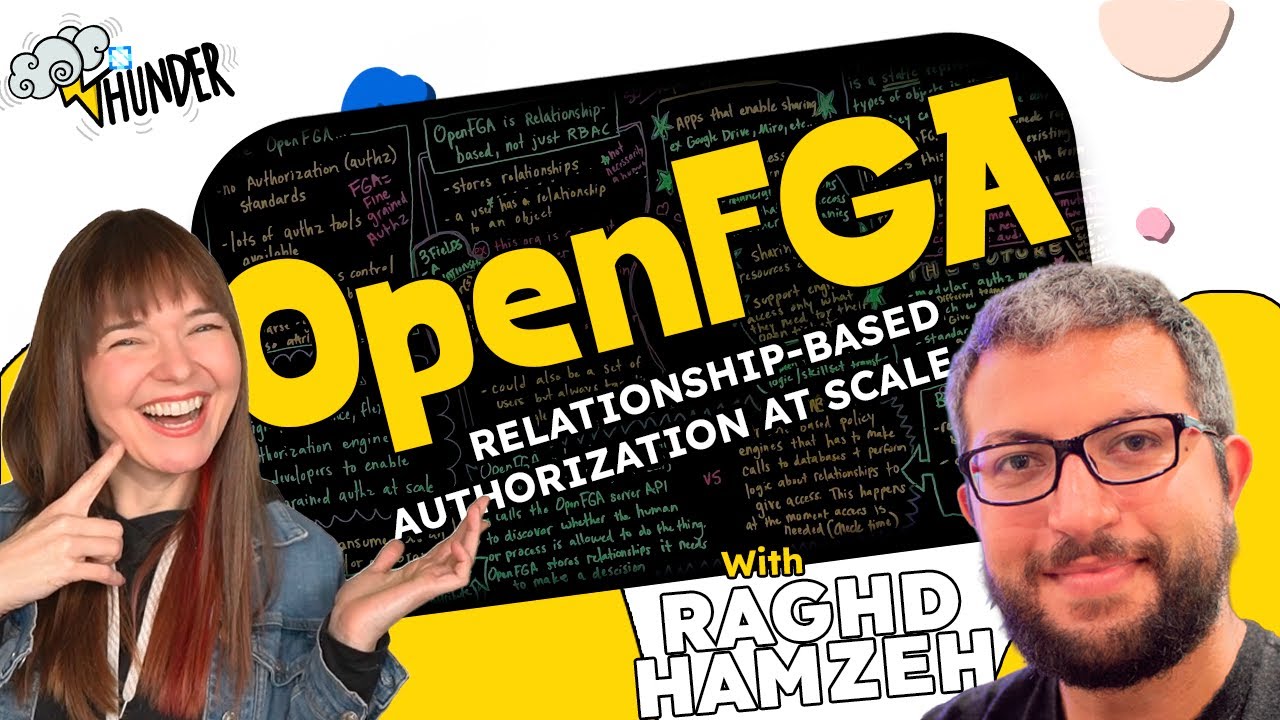
- No authorization (authz) standards
- Lots of authz tools available
- Role-based access control (RBAC) exists, but is coarse-grained
- Also attribute-based access control (ABAC)
FGA = Fine Grained Authz
OpenFGA is a high-performance, flexible authorization engine built for developers to enable fine-grained authz at scale.
- Can be consumed as an API and/or a library
- Also SDKs to help with modeling
OpenFGA can't make decisions based on any attribute like ABAC can. (Update: Conditions now fully support attribute-based checks)
- Stores relationships (not necessarily a human)
- A user has a relationship to an object
- User
- Relation
- Object
Ex: This org is a parent to this other org
Ex: This user is an admin in the marketing org
Ex: Whitney is a follower of Raghd
- Could also be a set of users but always targeting a single object
OpenFGA gets the user identity from wherever (probably a token), then calls the OpenFGA server API to discover whether the human or process is allowed to do the thing.
OpenFGA stores relationships it needs to make a decision.
- Apps that enable sharing — ex: Google Drive, Miro, etc...
- Delegating access of sensitive information — financial institutions, orgs that give access to other companies
- Sharing nested resources at any level
- Support engineers access only what they need for their open tickets
- Easier to switch between teams — authz logic/skillset transfers
OpenFGA: Stores relationships it needs to make a decision.
ABAC: Attribute-based policy engines that have to make calls to databases and perform logic about relationships to give access. This happens at the moment access is needed (check time).
A static representation of the types of objects in your system and how they can relate to one another.
When OpenFGA receives a check request, it uses this model plus existing data to try and find a path from the user to the object being accessed.
Authorization model is immutable — can test a new model before release. Access is auditable (you can see who accessed what).
- Modular authz model — different teams can own different pieces (Update: Now available)
- Search with permissions — "Give me all the docs Whitney can view"
- Standardization around authz — a common language for each service (near term and long term)
- Relationship computation can be done before check time
- Data gathering is no longer required at check time
- Logic can be removed from application