
- Lista de idéias e oportunidades
Um brainstorm pode ajudar, seguindo suas regras de que nenhuma ideia deve ser descartada inicialmente e cada um apresenta uma ideia a cada rodada.
- Construção de um modelo de interesse
Através de metáforas, deve-se descrever os objetivos das ideias. Ex.: O taxista é uma hemácea, as células são os passageiros e nós somos o coração. Quando o coração bombeia o sangue, deve distribuir igualmente as hemáceas pelo corpo e, se elas ficarem paradas, serão descartadas. Este tipo de abordagem faz com que todos pensem e façam as coisas de maneira engajada e, através da metáfora, é possível saber se houve realmente um entendimento do objetivo.
- Histórias
Após identificar os objetivos e os clientes, as histórias devem levá-los como base de contrução. Ex. Eu, como taxista, devo ser chamado eventualmente para corridas, para manter meu engajamento. Neste caso, houve uma análise com os taxistas que exprime a necessidade de alguma ferramenta para atendê-los.
- Análise e acompanhamento da concorrência
-
Road Mapping Sessions 2x por mês com todos
- Novidades e KPIs
- Brainstorming
- Priorização
-
Divisão do Road Map em curto (até 3 meses), médio (até 6 meses) e longo (+6 meses) <-- isto gera muito "estoque"...
- Estar sempre [pelo menos 1 Sprint na frente] (http://www.methodsandtools.com/archive/uxrunway2.jpg) do Coder Sprint
- Scrum Meeting 2x por semana
- Eventualmente fazer o Sprint apenas para validar um Coder Sprint já em produção
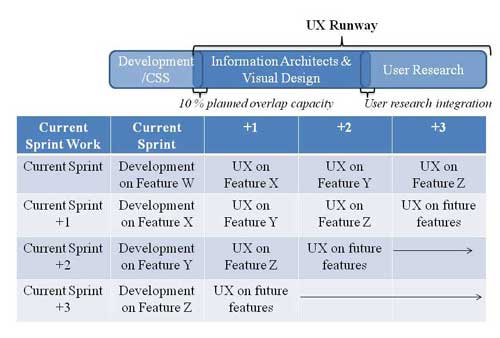
- UX Runway - Sprint Demo (não requerido)
- Apresentação demo de UX do próximo sprint (wireframes, comentários, análises, etc.)
- Discussão sobre barreiras técnicas
-
UX Runway - Scrum Planning
-
Retrospectiva
-
Planning técnico
-
Tarefas da Lista Priorizada de UX
- Definir tecnicamente cada tarefa
- Levantar pontos de pesquisa
- Levantar pontos críticos
- Fazer um checklist detalhado para cada tarefa
- Definir critério de aceitação
- Definir critério de validação (teste)
-
Tarefas da Lista de Bugs Priorizada de UX
- Atualizar e priorizar a lista
- Definir tecnicamente cada bug sem definição
- Migrar e ajustar se preciso bugs que não são relacionados a UX para a Lista de Débitos Técnicos
-
Tarefas da Lista de Débitos Técnicos
- Atualizar e priorizar a lista
- Definir tecnicamente cada tarefa sem definição
- Code Review todo dia (não requerido) às 14:00
- Scrum Meeting todo dia às 15:00
- Physically stand: There is a reason this meeting is also called the daily standup meeting. Standing seems to help people focus for short and high-energy meetings such as the daily scrum. Combining this with #2 can help you develop new habits if your team has a history of sitting during the daily standup.
- Stand around the task board: Having people point at the stories they are talking about is always more powerful than simply mentioning them verbally.
- Ask an additional question: In addition to the three statements, also ask: "How confident are you that you will get it done today?" People often complete statement #3 by saying they have no blocks. However, seconds later they often admit that they are only 50% confident that they will complete the story. Use this if your team members report no impediments for a while, but work doesn't seem to be moving along as fast as it should.
- Stick to the 15 minutes time-box: If your meetings take longer than 15 minutes people will start getting bored and are more likely to feel this meeting doesn't add any value for them. This normally indicates that something is wrong: maybe the team is too big, or maybe team members are using the meeting to solve problems instead of simply flagging them.
- Start and end the meeting on time: Daily standups often start late because the scrum master (or somebody else) is late. Start on time. Don't delay just because someone can't make it. Nothing says "this meeting is important" more than starting on time, even if 2/3 of people are not there yet.
- No distractions: Ensure everybody's focus is on the meeting. Don't fiddle around with your phone, or answer email, and definitely stop coding. It's worth it! Staying focused helps the meeting stay short and on track. It also demonstrates respect to your fellow team members.
- Defer to the 16th minute: Make sure you don't use the standup to solve problems. Instead, defer problem solving to the 16th minute, ie: after the daily scrum. This is even more important if your scrum team is distributed and your daily meetings take place over the phone.
- Keep the team engaged: People get bored easily, especially of repetitive things. Spice up the daily scrum meeting a little by introducing some uncertainty. For example, by passing around a token indicating whose turn it is to speak. This will keep them on their toes and engaged.
- Stop attending when it becomes a status update: Should your standup meeting ever turn into one of those meetings, stop attending. Sometimes, voting with your feet is the best way to facilitate change and make people realize something is wrong. And frankly, your time is probably better spent focusing on development anyway.
- Say thank you: Whenever a colleague has helped you or done something nice for you, acknowledge it. Nothing builds rapport and a good working relationship more than a simple "thank you!"
- Jam Session (Pair Programming e/ou ajuda) todo dia (não requerido) das 15:20 às 16:00
- Teste automático (de comportamento e/ou unitário) e/ou anexar descrição de como testar manualmente
- Se for aplicativo mobile, publicar binário em homolog no Testflight (PaxApp) ou Google Drive (Android) e anexar nome do binário