🡪 iicaras
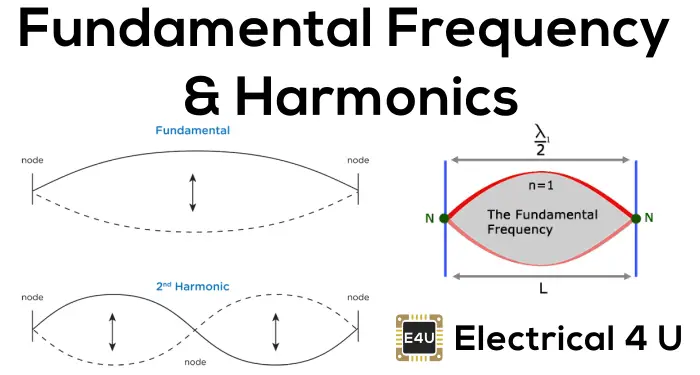
Image from Electrical4U [^harmonicsimage].
Harmonics can be understood from standing sine waves. A sine wave has 3 nodes. Therefore, the 'biggest' standing wave is the one where the first and second nodes define a constraining length $L$ such that half of its wavelength fits inside $L$. This is the fundamental. The second harmonic will have its entire wavelength fit inside $L$, since the end of the wavelength is now the node which sits at $L$. For the third harmonic, the next node is halfway through the second wavelength etc. Perhaps it is best visualised with a string. As such for wavelengths $\lambda_n$ with $n$ the harmonic number,


