
Last active
July 30, 2025 21:18
-
-
Save encse/1211f94e1beb5111f675cfd839f2dc16 to your computer and use it in GitHub Desktop.
iq demodulation
This file contains hidden or bidirectional Unicode text that may be interpreted or compiled differently than what appears below. To review, open the file in an editor that reveals hidden Unicode characters.
Learn more about bidirectional Unicode characters
| import matplotlib.pyplot as plt | |
| import numpy as np | |
| from scipy import signal | |
| # Source: https://github.com/guillaume-chevalier/filtering-stft-and-laplace-transform | |
| def butter_lowpass_filter(data, cutoff_freq, sampling_freq, order=4): | |
| nyq_freq = 0.5 * sampling_freq | |
| normal_cutoff = float(cutoff_freq) / nyq_freq | |
| b, a = signal.butter(order, normal_cutoff, btype='lowpass') | |
| y = signal.filtfilt(b, a, data) | |
| return y | |
| # helper, multiply with this to convert deg to rad | |
| rad = np.pi/180 | |
| # these are the parameters of our transmitted signal. | |
| # a * np.cos(2*Pi*freq * t - phi) | |
| phi = 45 * rad | |
| a = 1 | |
| freq = 50 | |
| # this is the 'receiver' side, it needs to 'sample' the signal we are sending: | |
| sampling_freq = 2000 | |
| t = np.linspace(0,1,sampling_freq) | |
| omega = 2*np.pi*freq | |
| signal_received = a * np.cos(omega * t - phi) | |
| # we can also add some noise if we want: | |
| # noise = 1 + 0.5 * np.random.uniform(-0.5, 0.5, sampling_freq) | |
| # signal_received = signal_received * noise | |
| # get i and q with a multuplication and a lowpass filteR: | |
| signali = signal_received * np.sin(omega*t) | |
| signali = butter_lowpass_filter(signali, freq, sampling_freq) | |
| signalq = signal_received * np.cos(omega*t) | |
| signalq = butter_lowpass_filter(signalq, freq, sampling_freq) | |
| # we can get the amplitude back with this: | |
| magnitude = 2 * np.sqrt(signali**2 + signalq**2) | |
| plt.plot(magnitude, label="magnitude") | |
| # we can get the 'angle' back with this: | |
| freq = np.arctan2(signali, signalq) | |
| plt.plot(freq / rad, label="angle") | |
| plt.legend() | |
| plt.show() |

Author
Author
These are the equations I used, you can check them using the rules for sin(x+y) and cos(x+y)
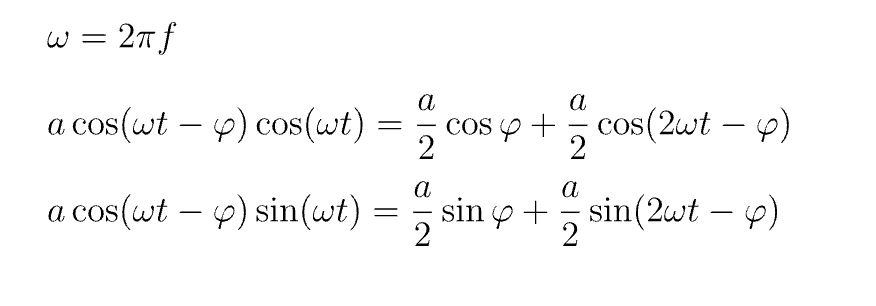
two more for completeness:
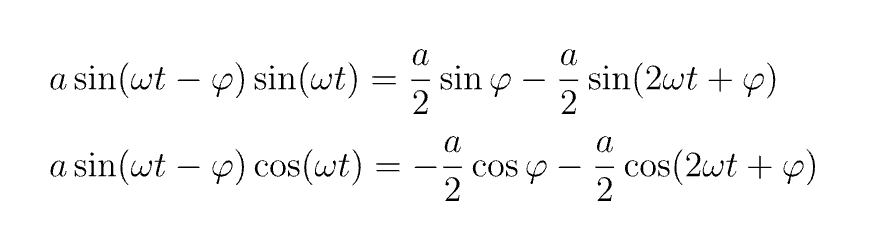
Let's hope I didn't make a mistake somewhere.
Sign up for free
to join this conversation on GitHub.
Already have an account?
Sign in to comment
This is the schematics of an sdr, you can find the multiplication and filtering towards the output.