
-
-
Save colinhacks/c40519a6a050a99091862319151377ec to your computer and use it in GitHub Desktop.
| // ⚠️ works with Emotion 10 only! ⚠️ | |
| // 1. `yarn add emotion-server` | |
| // 2. copy the contents of this file into your `pages` directory | |
| // 3. save it as `_document.tsx` | |
| // should work out of the box | |
| import Document, { Head, Main, NextScript } from 'next/document'; | |
| import { extractCritical } from 'emotion-server'; | |
| export default class MyDocument extends Document { | |
| static async getInitialProps(ctx: any) { | |
| const initialProps = await Document.getInitialProps(ctx); | |
| const styles = extractCritical(initialProps.html); | |
| return { | |
| ...initialProps, | |
| styles: ( | |
| <> | |
| {initialProps.styles} | |
| <style | |
| data-emotion-css={styles.ids.join(' ')} | |
| dangerouslySetInnerHTML={{ __html: styles.css }} | |
| /> | |
| </> | |
| ), | |
| }; | |
| } | |
| render() { | |
| return ( | |
| <html> | |
| <Head /> | |
| <body> | |
| <Main /> | |
| <NextScript /> | |
| </body> | |
| </html> | |
| ); | |
| } | |
| } |


Hi @colinhacks, came from your article on
@emotion/corevs Vanilla Emotion.This is interesting to me too: it would be nice to have students at @upleveled avoid the footgun of using the
cssprop on an<a>inside of a Next.js<Link>and then thehrefnot being passed (see the problem at this CodeSandbox)I am not sure this is up to date with Emotion 11 though - do you have a more current version of this? For example, when I look at the version on the Emotion docs, it imports
createEmotionServerfrom@emotion/server/create-instanceand then creates a server, before finally destructuringextractCriticalout of it.Oh and if you do have a version, does it also use a function component instead of a class component (since Next.js supports this now)?
Full disclosure:
I am brand new to NextJS and Emotion. These seem relevant - but take them with a grain of salt.
@karlhorky, I thought this might interest you
https://emotion.sh/docs/ssr
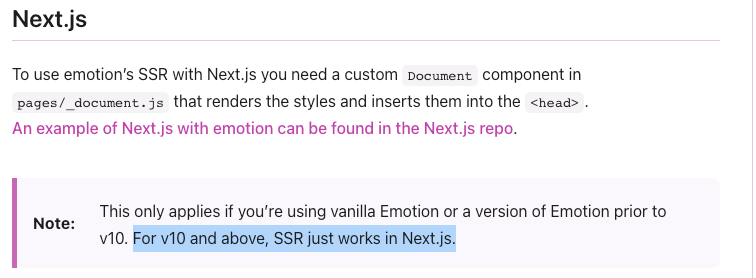
The sentence I've highlighted seems misleading or possibly incomplete. I assume they mean emotion-server (pre Emotion 11) or @emotion/server (Emotion 11). But maybe perhaps I'm wrong.
Also check out their Emotion 11 notes here: https://emotion.sh/docs/emotion-11
@bcourtney5965 Thanks for the response :)
The highlighted sentence applies to @emotion/core (actually now called @emotion/react in v11).
I worked on the current official example in the Next.js repo to bring this up to date:
What this Gist is talking about is Vanilla emotion - which is a completely different animal :)

@karlhorky you're totally right, this is for Emotion 10 specifically. I'll update my blog post to indicate that. I don't have upgraded versions at this time, i'll try to get around to it soon though.
Ok great, thanks!
Ah I see, thank you karlhorky for the clarification. And thank you colinhacks for the writeup.

In latest Nextjs i have this that seems to work for me - typescript version. emotion >= 11
yarn add @emotion/server- copy the contents of this file into your
pagesdirectory - save it as
_document.tsx
_document.tsx
import * as React from 'react';
import Document, {
  DocumentContext,
  Head,
  Html,
  Main,
  NextScript,
} from 'next/document';
import { extractCritical } from '@emotion/server';

export default class AppDocument extends Document {
  static async getInitialProps(
    ctx: DocumentContext
  ): ReturnType<typeof Document.getInitialProps> {
    const initialProps = await Document.getInitialProps(ctx);
    const styles = extractCritical(initialProps.html);

    return {
      ...initialProps,
      styles: (
        <React.Fragment>
          {initialProps.styles}
          <style
            data-emotion-css={styles.ids.join(' ')}
            dangerouslySetInnerHTML={{ __html: styles.css }}
          />
        </React.Fragment>
      ),
    };
  }

  render(): JSX.Element {
    return (
      <Html>
        <Head />
        <body>
          <Main />
          <NextScript />
        </body>
      </Html>
    );
  }
}
yarn add @emotion/css @emotion/react- copy the contents of this file into your
pagesdirectory - save it as
_app.tsx
_app.tsx
import * as React from 'react';
import { cache } from '@emotion/css';
import { CacheProvider } from '@emotion/react';
import type { AppProps } from 'next/app';

function App(props: AppProps): JSX.Element {
  const { Component, pageProps } = props;

  return (
    <CacheProvider value={cache}>
        <Component {...pageProps} />
    </CacheProvider>
  );
}

export default App;
Hope that helps
Very cool @MMT-LD! 💯 Maybe the Next.js team would actually accept this as a further example in the /examples directory - maybe called with-emotion-vanilla or with-vanilla-emotion - to provide an alternative to the with-emotion example.
cc @lfades - this would be an example of how to use Next.js with vanilla Emotion (as opposed to @emotion/react
Diclaimer - not fully tested this its rough but think it'll work.
Another way to get this to work with the custom way (if you want a custom config) would be...
shared/emotion.ts
import createEmotion from '@emotion/css/create-instance';
export const {
  flush,
  hydrate,
  cx,
  getRegisteredStyles,
  injectGlobal,
  keyframes,
  css,
  cache,
  sheet,
} = createEmotion({ key: 'css-whatever' });
_document.tsx - note the new import shared/emotion and @emotion/server/create-instance
import * as React from 'react';
import Document, {
  DocumentContext,
  Head,
  Html,
  Main,
  NextScript,
} from 'next/document';
import createEmotionServer from '@emotion/server/create-instance';
import { cache } from 'shared/emotion';

const { extractCritical } = createEmotionServer(cache);

export default class AppDocument extends Document {
  static async getInitialProps(
    ctx: DocumentContext
  ): ReturnType<typeof Document.getInitialProps> {
    const initialProps = await Document.getInitialProps(ctx);
    const styles = extractCritical(initialProps.html);

    return {
      ...initialProps,
      styles: (
        <React.Fragment>
          {initialProps.styles}
          <style
            data-emotion-css={styles.ids.join(' ')}
            dangerouslySetInnerHTML={{ __html: styles.css }}
          />
        </React.Fragment>
      ),
    };
  }

  render(): JSX.Element {
    return (
      <Html>
        <Head />
        <body>
          <Main />
          <NextScript />
        </body>
      </Html>
    );
  }
}
_app.tsx - note the new import shared/emotion
import * as React from 'react';
import { cache } from 'shared/emotion';
import { CacheProvider } from '@emotion/react';
import type { AppProps } from 'next/app';

function App(props: AppProps): JSX.Element {
  const { Component, pageProps } = props;

  return (
    <CacheProvider value={cache}>
        <Component {...pageProps} />
    </CacheProvider>
  );
}

export default App;
Doing it this way is a little maintenance, however, more flexible. All that is required is to use the css, keyframes etc etc from shared/emotion rather than emotion css. When styling your app. The css classname should now have classname='css-whatever-randomstring'. For example,
import { css } from 'shared/emotion';
const style = css({ color: 'white', padding: 0, background: 'red' });
<div className={style}>cool</div>
Nice, thanks!
I've opened a Next.js issue to see if they are interested in this: vercel/next.js#20199
Hi @colinhacks, came from your article on
@emotion/corevs Vanilla Emotion.This is interesting to me too: it would be nice to have students at @upleveled avoid the footgun of using the
cssprop on an<a>inside of a Next.js<Link>and then thehrefnot being passed (see the problem at this CodeSandbox)I am not sure this is up to date with Emotion 11 though - do you have a more current version of this? For example, when I look at the version on the Emotion docs, it imports
createEmotionServerfrom@emotion/server/create-instanceand then creates a server, before finally destructuringextractCriticalout of it.Oh and if you do have a version, does it also use a function component instead of a class component (since Next.js supports this now)?